Case Sofia: Overcoming a Specific Phobia with Brief Strategic Therapy
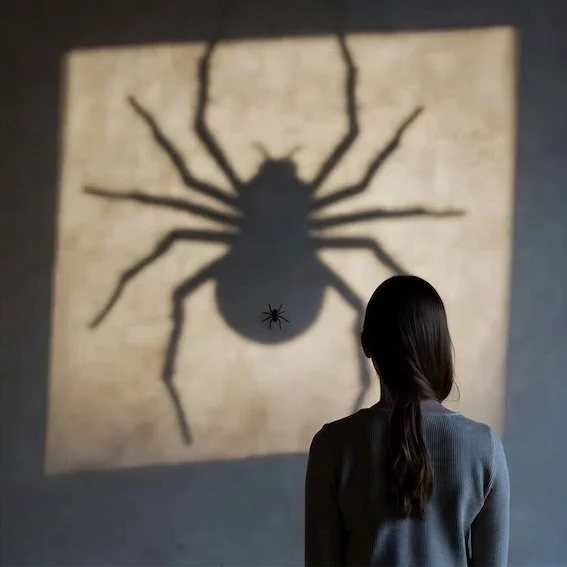
“We suffer more often in imagination than in reality”
Understanding Sofia's Fear
Most of the people who seek therapy for phobias are strong, competent, and highly functional in every other area of their lives. Yet, in the presence of a specific fear, they can feel completely powerless. The following is a real clinical case I treated, with identifying details changed to protect confidentiality and published with the client’s informed consent. It illustrates how fear becomes entrenched over time and how Brief Strategic Therapy (BST) can dissolve even long-standing phobic responses.
Sofia was a 30-year-old woman: confident, successful, and independent. She worked as a paediatric nurse and loved her job. She described herself as having what she called more “masculine” traits: she enjoyed DIY, did not shy away from using her physical strength when needed, and did not identify with traditional gender roles such as expecting doors to be held open or chairs pulled out for her. Yet despite this strong and self-reliant identity, Sofia was terrified of spiders.
She lived in a house in the countryside, where spiders were unavoidable. When she encountered one, her reaction was extreme: she would freeze, scream, cry, and become completely paralysed. She was unable to move until her husband removed or killed the spider. Only then could she continue with what she was doing. She contacted me specifically to overcome her phobia.
During the first session, Sofia explained that there had been no traumatic experience involving spiders and no clear trigger for the phobia. She herself described it as irrational. The fear had developed gradually and intensified over time, becoming unmanageable when she moved to the countryside and had to coexist with spiders on a regular basis.
From a Brief Strategic Therapy perspective, we explored her attempted solutions—the behaviours that, rather than solving the problem, were maintaining and amplifying it. In Sofia’s case, the two dominant psychological traps were avoidance (not approaching, touching, removing, or even looking at spiders) and seeking help (relying on her husband to remove or kill the spider whenever she felt paralysed). These strategies provided short-term relief but reinforced the perception of danger and helplessness, allowing the fear to grow over time.
In that first session, we also clarified Sofia’s therapeutic goals. She wanted to be able to see a spider without feeling paralysed or overwhelmed by anxiety, to leave it alone if possible, and—if removal was necessary—to be able to do it herself, without needing her husband’s help.
Techniques Used and Their Effects
I applied the BST protocol for specific phobias. We began by restructuring the effects of avoidance and help-seeking, helping Sofia understand how these strategies had unintentionally strengthened her fear. Next, we tested her limits by exploring how close she could get to a spider in a structured and gradual way. This allowed us to establish a baseline. To her surprise, Sofia discovered that she could tolerate being closer than she had imagined, although her anxiety remained high. She was asked to carry out this task systematically and to keep written notes of her observations.
I also prescribed the Worst Fantasy (WF) technique, a cornerstone intervention in phobic treatment within BST. When used correctly, this technique produces a paradoxical effect: by deliberately evoking fear in a controlled way, anxiety diminishes.
After completing the initial tasks, Sofia reported feeling less frightened, though not yet ready for close contact. Once the WF training was consolidated, I asked her to begin “getting to know her enemy.” She started by reading about spiders without images and later progressed to looking at pictures.
After two weeks, Sofia reported a remarkable shift: instead of fear, she felt curiosity and even fascination for these creatures. She had learned facts about spiders she had never known before, and her emotional response to them had changed significantly.
At this point, we moved into the counter-avoidance phase, a guided and strategic form of exposure designed to reverse avoidance patterns without overwhelming the client.
Over the course of eight sessions, Sofia achieved all her goals. She later sent me a video (shown below), which provides clear and compelling evidence of her recovery.
Clinical Reflections: How Brief Strategic Therapy Changes Phobic Patterns
Sofia’s attempted solutions were typical of phobic functioning: avoidance and seeking help. While these strategies reduced anxiety in the short term, they progressively reinforced the perception of danger and personal incapacity, allowing the fear to escalate.
The test your limits exercise, designed to assess how close Sofia could tolerate being to a spider, also included a distraction component. This intervention draws on a classical Chinese stratagem often referred to as “crossing the sea without the sky noticing.” Strategies based on this principle introduce a deliberate shift in focus, allowing the person to carry out actions that would otherwise feel impossible. In Sofia’s case, this indirect approach enabled her to move closer to the feared object without confronting the fear directly. Crucially, this became her first corrective emotional experience: Sofia discovered that she was able to be closer to a spider than she had initially believed, breaking the first resistance and opening the door to subsequent therapeutic change.
The Worst Fantasy (WF) technique, as previously described, played a central role in preparing the ground for change. This paradoxical intervention reduces anxiety by asking the person to intentionally evoke their worst fears. Through repeated practice, Sofia learned that when fear was deliberately sought rather than avoided, its intensity diminished. This experience was essential in preparing her for the subsequent counter-avoidance phase.
Another key element was “getting to know the enemy.” By learning factual information about spiders and gradually exposing herself to images, Sofia began to perceive the phobic object from a different perspective. Often, fear is amplified by the unknown; familiarity allowed curiosity to replace catastrophic expectations.
Finally, the counter-avoidance phase produced the decisive corrective emotional experience. Through guided and progressive exposure, Sofia discovered that being close to spiders did not overwhelm her; instead, it made her feel increasingly capable, braver, and less afraid over time. Each successful encounter reinforced new emotional learning, making her more willing to repeat the behaviour. This process ultimately led to a profound shift in her perception of spiders and, consequently, in her emotional and behavioural response to them.
Sofia’s story is a reminder that fear is not a sign of weakness, but the result of patterns that can be understood and changed. Even long-standing phobias can be overcome when the focus shifts from why we are afraid to how fear is maintained—and how it can be strategically addressed through Brief Strategic Therapy.
As Nelson Mandela said, “I learned that courage was not the absence of fear, but the triumph over it.”
This short video shows a moment that would have been unthinkable for Sofia at the start of therapy. After completing the therapeutic process, she is able to calmly pick up a spider and allow it to rest in her hands. Her movements are slow and deliberate, and there are no visible signs of panic or avoidance. Sofia later remarked that the spider had a very soft and velvety touch and that she was positively impressed by it; however, this comment cannot be heard in the video, which is muted to protect her identity.
If a phobia—whether a specific fear like spiders or a more complex pattern—is limiting your life, and you would like professional support to overcome it, I invite you to reach out and explore how Brief Strategic Therapy can help you regain control and reduce fear.